

A Volatile Week, A Resilient Economy
Pending Home Sales
Pending home sales fell 9.3% in December 2025, one of the largest monthly declines in the modern series. This sharp reversal, following several months of gains, came in far weaker than forecasts that had called for little change. All four U.S. regions posted month-over-month losses, with the Midwest (-14.9%) and West (-13.3%) hit hardest. National Association of Realtors Chief Economist Lawrence Yun attributed the pullback to shrinking inventory: while home closings rose in December, new listings failed to keep pace, leaving just 1.18 million homes on the market (the lowest level of 2025) and dampening buyer willingness to commit.
National Association of Realtors (2026) NAR Pending Home Sales Report Shows 9.3% Decrease in December. Available at: https://www.nar.realtor/newsroom/nar-pending-home-sales-report-shows-9-3-decrease-in-december (Accessed: 23 January 2026).
Gross Domestic Product (GDP)
The U.S. economy grew at an annualized rate of 4.4% in the third quarter of 2025, the fastest expansion in two years. Gross Domestic Product (GDP), which measures the total value of goods and services produced in the country, was revised up from an initial 4.3% estimate. Consumer spending, the largest driver of economic activity, rose 3.5%, its strongest quarterly pace so far this year. Exports surged 9.6%, rebounding sharply after declining 1.8% the previous quarter. Government spending turned positive at 2.2% after a slight contraction in Q2.
Looking Ahead
The Atlanta Fed's GDPNow model, a real-time estimate that updates as new data arrives, projects Q4 2025 GDP growth at 5.4% as of January 21, 2026. If accurate, this would mark an acceleration from Q3's already strong pace. Note: GDPNow is a model-based estimate, not an official forecast, and may change materially as additional data are released.
U.S. Bureau of Economic Analysis (2026) Gross Domestic Product, 3rd Quarter 2025 (Updated Estimate). Available at: https://www.bea.gov/news/2026/gross-domestic-product-3rd-quarter-2025-updated-estimate-gdp-industry-and-corporate (Accessed: 22 January 2026).
Federal Reserve Bank of Atlanta (2026) GDPNow. Available at: https://www.atlantafed.org/cqer/research/gdpnow (Accessed: 21 January 2026).
Initial Jobless Claims
Initial jobless claims (the number of people filing for unemployment benefits for the first time after losing a job) edged up by 1,000 to 200,000 for the week ending January 17th. This figure came in well below the 210,000 economists had expected. The four-week moving average, which smooths out weekly fluctuations to reveal underlying trends, declined to 201,500. Meanwhile, continuing claims (people who remain on unemployment benefits after their initial filing) fell by 26,000 to 1,849,000. These figures reflect what economists describe as a "low-hiring, low-firing" labor market: employers are neither aggressively adding workers nor cutting them, creating unusual stability.
U.S. Department of Labor, Employment and Training Administration (2026) Unemployment Insurance Weekly Claims Report. Available at: https://www.dol.gov/ui/data.pdf (Accessed: 22 January 2026).
Personal Consumption Expenditures (PCE) - Inflation
The Personal Consumption Expenditures (PCE) Price Index—the Federal Reserve's preferred measure of inflation because it captures a broader range of consumer spending and adjusts for changes in buying habits—rose at an annualized rate of 2.80% in the third quarter of 2025. This marks an acceleration from the 2.10% pace recorded in the second quarter, representing a 0.70 percentage point increase. While prices are rising faster than earlier this year, the current rate remains below the long-term historical average of 3.14% recorded since 1947. The Fed watches PCE closely when deciding whether to raise, lower, or hold interest rates steady.
Looking Ahead
The Cleveland Fed's Inflation Nowcasting model—a real-time estimate that updates daily as new data arrives—provides the following projections as of January 22, 2026: the nowcast for January 2026 estimates PCE inflation at 2.58% year-over-year, with Core PCE (which excludes volatile food and energy prices) at 2.76%. For the fourth quarter of 2025, the model estimates PCE inflation running at a 2.62% annualized rate. These figures suggest inflation remains above the Fed's 2% target but has moderated from the third quarter's pace. Note: Nowcasts are model-based estimates, not official data, and may change as additional information is released.
U.S. Bureau of Economic Analysis (2025) Personal Consumption Expenditures Price Index. Available at: https://www.bea.gov/data/personal-consumption-expenditures-price-index (Accessed: 22 January 2026).
Federal Reserve Bank of Cleveland (2026) Inflation Nowcasting. Available at: https://www.clevelandfed.org/indicators-and-data/inflation-nowcasting (Accessed: 22 January 2026).
Disclosure
This material is provided by Todd Van Der Meid, MBA, CFP®, through Rhino Wealth Management, Inc., a Registered Investment Adviser, solely for informational purposes. It is not intended as investment, tax, legal, or accounting advice. Investors should consult qualified professionals before making financial decisions.
Opinions expressed herein are general in nature and not tailored to individual circumstances. Investment strategies discussed may not be suitable for every investor. All investments carry risk, including possible loss of principal, and past performance does not guarantee future results. No investment strategy or risk management technique ensures profit or eliminates risk in all market conditions.
Investments in foreign or emerging markets involve additional risks, such as currency fluctuations, geopolitical instability, and varying accounting standards. Sector-specific investments can be more volatile due to their concentrated nature. References to indexes are for illustrative purposes; indexes are unmanaged, cannot be invested into directly, and their performance does not reflect fees, expenses, or sales charges. Index performance is not indicative of specific investment performance.
Economic forecasts and forward-looking statements reflect current views and assumptions and are subject to change. Actual results may vary materially due to market or other conditions. There is no obligation to update forward-looking information.
Information presented herein comes from reliable third-party sources but is not guaranteed for accuracy or completeness. Rhino Wealth Management, Inc. disclaims liability for errors or omissions. Portions of this content may be generated using advanced analytical tools, including artificial intelligence, and all such content has been reviewed and validated by Todd Van Der Meid, MBA, CFP®, using proprietary quality-control measures. Rhino Wealth Management, Inc. does not directly hold securities; however, securities mentioned may be included within recommended portfolio models or held by clients. Please refer to our Form ADV for additional details regarding potential conflicts of interest.
Market and Economic Update
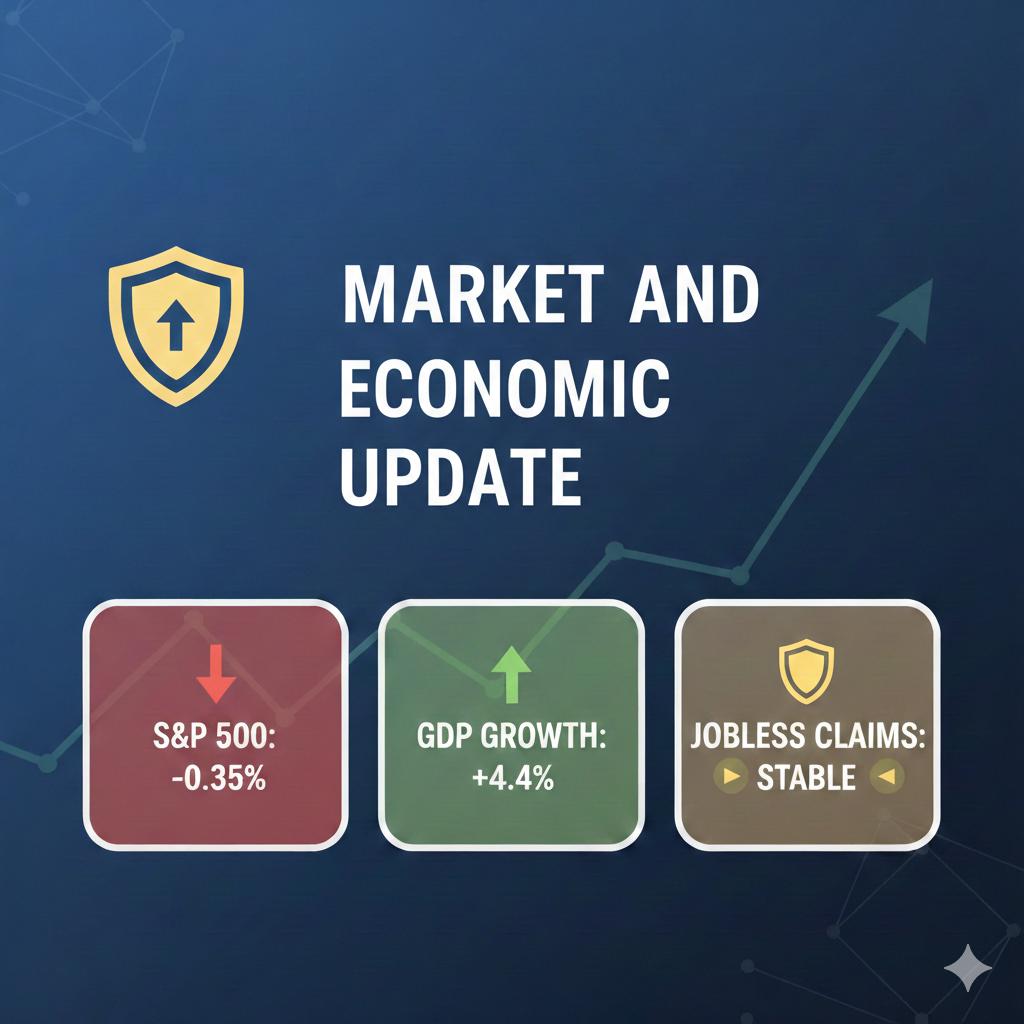
The S&P 500 finished the volatile holiday shortened week down 0.35%. Tensions over Greenland rattled markets after European troops arrived on the Danish territory last week at Denmark's invitation, prompting a sharp response from Washington. On Saturday, President Trump announced via social media that eight European nations participating in the deployment (Denmark, Norway, Sweden, France, Germany, the UK, the Netherlands, and Finland) would face a 10% tariff on all imports effective February 1, rising to 25% on June 1 unless a deal is reached for the U.S. to acquire Greenland. Markets were closed Monday for Martin Luther King Jr. Day, then fell 2% Tuesday on tariff fears.
Markets rallied Wednesday after President Trump dialed back his Greenland threats on two fronts. Speaking at the World Economic Forum in Davos, Switzerland, he took military action off the table and called for "immediate negotiations." Later that afternoon, stocks surged further when President Trump announced he had reached "the framework of a future deal" with NATO Secretary General Mark Rutte on Arctic security, and would not impose the threatened tariffs. The S&P 500 gained 1.2%, recovering a portion of Tuesday's decline.
While markets welcomed the de-escalation, the underlying dispute remains unresolved. The "framework" announced by President Trump and NATO Secretary General Rutte focused on Arctic security cooperation, not Greenland's sovereignty. Denmark has maintained that Greenland is not for sale, and President Trump has not abandoned his goal of acquiring the territory. Danish Prime Minister Mette Frederiksen told Reuters Thursday that "the American ambition to take over Greenland is intact." Investors should expect this issue to resurface.
Beyond the Greenland headlines, the underlying economy remains on solid footing. GDP grew at an annualized 4.4% in the third quarter, the fastest pace in two years and well above long-term trends. Consumer spending, which accounts for roughly two-thirds of economic activity, rose 3.5%, its strongest quarterly showing of 2025. The labor market continues to exhibit unusual stability: initial jobless claims remain low, and the "low-hiring, low-firing" dynamic means most Americans who want jobs have them and are spending accordingly. Inflation remains above the Fed's 2% target and picked up in Q3, though real-time estimates suggest it may be moderating as we head into 2026.
Not every corner of the economy shares in this strength. Housing remains under strain, with mortgage rates hovering above 6% as longer-dated Treasury yields have stayed elevated despite cuts to short-term rates. Why the disconnect? Strong economic growth gives investors little incentive to seek safety in bonds, while persistent deficit spending has flooded the market with Treasury supply. Add in inflation expectations that remain above target, and bondholders continue to demand higher compensation. The December pending home sales data, down 9.3% month-over-month, reflects buyers pulling back as affordability constraints and shrinking inventory weigh on the market. For now, housing appears to be a pocket of weakness within an otherwise resilient economy rather than a warning sign of broader trouble ahead.
On a separate note, President Trump indicated Wednesday that he is close to selecting the next Federal Reserve chair. In a CNBC interview at Davos, he said the search that began in September with 11 candidates is nearly over. "I'd say we're down to three, but we're down to two. And I probably can tell you, we're down to maybe one, in my mind," President Trump said. Finalists reported by the media include Kevin Warsh, Christopher Waller, Kevin Hassett, and BlackRock fixed income head Rick Rieder. President Trump called Rieder "very impressive" following their recent meeting. Current Chair Jerome Powell's term expires in May 2026.