

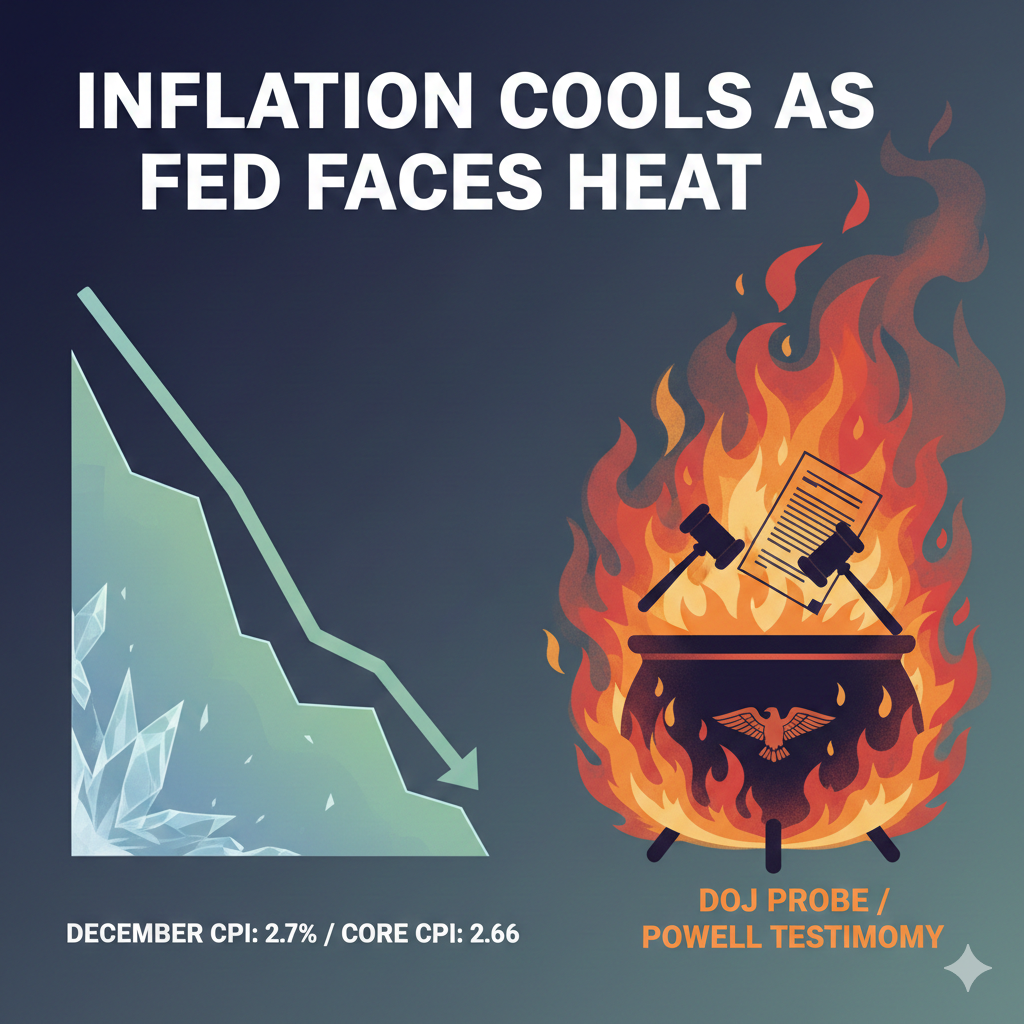
Inflation Cools as Fed Faces Heat
The S&P 500 finished the week down 0.38% amid mixed economic signals and renewed uncertainty about Federal Reserve independence as the U.S. Department of Justice opened a criminal investigation into Federal Reserve Chair Jerome Powell.
December's CPI report offered encouraging news on inflation. Core prices rose 2.6% annually, the slowest pace since March 2021, while headline inflation came in at 2.7% year-over-year. The Federal Reserve Bank of Cleveland's Nowcast expects January inflation to fall below 2.4%.
Markets are pricing in a 95% probability the Fed holds rates steady at its January meeting, according to the CME FedWatch Tool, with only two cuts expected through 2027. The Fed cut rates three times in 2025 as inflation stabilized but now appears content to pause while assessing the economic landscape.
The labor market tells a nuanced story. Initial jobless claims fell to 198,000, well below expectations, and the four-week average hit its lowest level since January 2024. Yet this reflects a "low firing, low hiring" environment rather than robust expansion.
Economic growth remains strong on paper. The Atlanta Fed's GDPNow model estimates Q4 2025 real GDP growth at 5.3%, driven largely by consumer spending and continued AI infrastructure investment. That spending has been a key engine of growth, but it also represents a vulnerability: if companies pull back on AI buildouts, the economy loses a significant tailwind.
For now, the data paints a picture of an economy that's cooling but not cracking, with inflation moderating and employment holding steady.
DOJ Opens Criminal Investigation Into Federal Reserve Chair Powell
The U.S. Department of Justice is conducting a criminal investigation into Federal Reserve Chair Jerome Powell. The probe, led by U.S. Attorney Jeanine Pirro through the District of Columbia office, focuses on Powell's June 2025 congressional testimony about the estimated $2.5 billion cost of renovating the Federal Reserve's Washington headquarters. Investigators are examining whether Powell made inaccurate or misleading statements.
Grand jury subpoenas were served on the Federal Reserve on January 9, 2026. Pirro stated her office made multiple attempts to obtain information on cost overruns without response, calling the subpoenas a necessary step and emphasizing that "no one is above the law."
In a video statement released Sunday evening, Powell called the investigation unprecedented, suggesting it stems from administration pressure on interest rate policy rather than renovation concerns. "The threat of criminal charges is a consequence of the Federal Reserve setting interest rates based on our best assessment of what will serve the public, rather than following the preferences of the President," Powell said.
President Trump stated he has no knowledge of the probe.
The investigation has drawn sharp criticism. Former Federal Reserve Chairs Janet Yellen, Ben Bernanke, and Alan Greenspan joined former Treasury Secretaries including Tim Geithner, Jacob Lew, and Hank Paulson in a joint statement on January 12, 2026, condemning the probe as an "unprecedented attempt to use prosecutorial attacks to undermine" the central bank's independence. They warned this approach resembles "how monetary policy is made in emerging markets with weak institutions."
On January 13, 2026, eleven global central bank leaders issued a rare coordinated statement expressing solidarity with Powell. Signatories included European Central Bank President Christine Lagarde, Bank of England Governor Andrew Bailey, Bank of Canada Governor Tiff Macklem, and Bank of Korea Governor Chang Yong Rhee. "The independence of central banks is a cornerstone of price, financial and economic stability," they wrote. "Chair Powell has served with integrity, focused on his mandate and an unwavering commitment to the public interest."
Bipartisan lawmakers have raised concerns about risks to the Federal Reserve's institutional autonomy. Republican Senator Thom Tillis of North Carolina announced he would block any Trump nominees to the Federal Reserve until the legal matter is resolved. Republican Senator Lisa Murkowski of Alaska called the investigation "nothing more than an attempt at coercion."
Financial markets have shown a muted response, with major equity indices and bond yields exhibiting minimal volatility in the days following the announcement. Market participants largely view any path to conviction as lengthy and difficult. Prosecutors would need to prove clear intent to mislead Congress, a high evidentiary bar that is hard to clear in cases involving public testimony on estimates and projections.
No charges have been filed. The investigation remains ongoing. Powell's term as chair expires in May 2026, though he could remain on the Federal Reserve Board as a governor through January 2028.
Board of Governors of the Federal Reserve System (2026) Statement from Federal Reserve Chair Jerome H. Powell. Available at: https://www.federalreserve.gov/newsevents/speech/powell20260111a.htm (Accessed: 13 January 2026).
Consumer Price Index (CPI)
The Consumer Price Index (CPI), the government's main measure of what Americans pay for goods and services, showed annual inflation holding steady at 2.7% in December. Prices rose 0.3% from November, matching expectations. Shelter costs, which include rent and homeowner expenses, drove most of the monthly increase with a 0.4% rise. Food prices accelerated to 3.1% annually, while energy costs moderated significantly as gasoline prices fell 3.4% compared to last year. The data suggests inflation remains above the Federal Reserve's 2% target but is not accelerating.
U.S. Bureau of Labor Statistics (2026) Consumer Price Index Summary. Available at: https://www.bls.gov/cpi/ (Accessed: 13 January 2026).
Core Inflation
What is core inflation? Core inflation strips out food and energy prices from the calculation. Why? Because grocery and fuel costs swing wildly from month to month due to weather, geopolitics, and seasonal factors. These swings can mask what's really happening with underlying prices.
Why it matters: The Federal Reserve watches core inflation closely when deciding interest rates. It reveals the sticky, persistent price trends that monetary policy can actually influence, rather than temporary spikes from a cold winter or oil disruption.
Core inflation held at 2.6% annually, its lowest reading since March 2021 and a sign that underlying price pressures continue to ease. The monthly increase of just 0.2% came in below the expected 0.3%, which is encouraging news for the Fed. Shelter remains the largest contributor to core inflation at 3.2% annually, though used vehicle prices are now cooling with a 1.1% monthly decline. Services excluding energy rose 0.3% for the month. The softer-than-expected reading suggests the Fed's interest rate policy is working to bring inflation back toward its 2% goal.
U.S. Bureau of Labor Statistics (2026) Consumer Price Index Summary. Available at: https://www.bls.gov/cpi/ (Accessed: 13 January 2026).
U.S. Housing Market Dashboard
New Construction (October 2025) & Existing Homes (December 2025) & Builder Sentiment (January 2026)
New Construction
Existing Homes
Builder Sentiment
Something interesting is happening in the housing market. For the first time since mid-2025, newly built homes are actually cheaper than existing ones. That's not an accident.
Builders are feeling the squeeze. Their confidence fell again in January, with the NAHB Housing Market Index dropping to 37. Above 50 would signal optimism. Builders aren't there. To move inventory, 40% are now cutting prices—the third consecutive month at that level, something not seen since May 2020—and two-thirds are offering incentives like rate buydowns and closing cost credits. The result? New home prices have dropped 8% from last year, landing at $392,300 in October, roughly $13,000 less than December's median existing home price of $405,400.
Meanwhile, the resale market is finally showing signs of life. December existing home sales jumped 5.1% to their fastest pace in nearly three years, with gains across all four U.S. regions. Lower mortgage rates in the fall helped pull some buyers off the sidelines, and price growth has slowed to a crawl, up just 0.4% from last year.
But here's the catch: there's almost nothing to buy. Existing home inventory sits at just 3.3 months of supply, far below the 5-6 months considered healthy. Many homeowners locked in 3% mortgages during the pandemic and have little reason to sell into today's higher-rate environment. New construction, by contrast, offers nearly 8 months of supply.
The bottom line for buyers? If you're flexible on location and open to new builds, that's where the negotiating power is. The resale market remains tight, competitive, and priced accordingly.
U.S. Census Bureau and U.S. Department of Housing and Urban Development (2026) Monthly New Residential Sales, October 2025. Available at: https://www.census.gov/construction/nrs/current/index.html (Accessed: 16 January 2026).
National Association of Realtors (2026) Existing-Home Sales Report, December 2025. Available at: https://www.nar.realtor/newsroom/nar-existing-home-sales-report-shows-5-1-increase-in-december (Accessed: 16 January 2026).
National Association of Home Builders (2026) Builder Sentiment Loses Ground at Start of 2026. Available at: https://www.nahb.org/news-and-economics/press-releases/2026/01/builder-sentiment-loses-ground-at-start-of-2026 (Accessed: 16 January 2026).
Weekly Unemployment Insurance Claims
Initial jobless claims—the number of people filing for unemployment benefits for the first time—fell to 198,000 for the week ending January 10, one of the lowest readings in recent months. This figure came in well below market expectations of 215,000. The four-week moving average, which smooths out weekly volatility to show underlying trends, dropped to 205,000—its lowest level since January 2024. Continuing claims—people who remain on unemployment benefits after their initial filing—declined to 1.884 million. These figures reflect a labor market characterized by limited layoffs but also slower hiring, a pattern economists describe as "low firing, low hiring."
U.S. Department of Labor (2026) Unemployment Insurance Weekly Claims. Available at: https://www.dol.gov/ui/data.pdf (Accessed: 16 January 2026).
Disclosure
This material is provided by Todd Van Der Meid, MBA, CFP®, through Rhino Wealth Management, Inc., a Registered Investment Adviser, solely for informational purposes. It is not intended as investment, tax, legal, or accounting advice. Investors should consult qualified professionals before making financial decisions.
Opinions expressed herein are general in nature and not tailored to individual circumstances. Investment strategies discussed may not be suitable for every investor. All investments carry risk, including possible loss of principal, and past performance does not guarantee future results. No investment strategy or risk management technique ensures profit or eliminates risk in all market conditions.
Investments in foreign or emerging markets involve additional risks, such as currency fluctuations, geopolitical instability, and varying accounting standards. Sector-specific investments can be more volatile due to their concentrated nature. References to indexes are for illustrative purposes; indexes are unmanaged, cannot be invested into directly, and their performance does not reflect fees, expenses, or sales charges. Index performance is not indicative of specific investment performance.
Economic forecasts and forward-looking statements reflect current views and assumptions and are subject to change. Actual results may vary materially due to market or other conditions. There is no obligation to update forward-looking information.
Information presented herein comes from reliable third-party sources but is not guaranteed for accuracy or completeness. Rhino Wealth Management, Inc. disclaims liability for errors or omissions. Portions of this content may be generated using advanced analytical tools, including artificial intelligence, and all such content has been reviewed and validated by Todd Van Der Meid, MBA, CFP®, using proprietary quality-control measures. Rhino Wealth Management, Inc. does not directly hold securities; however, securities mentioned may be included within recommended portfolio models or held by clients. Please refer to our Form ADV for additional details regarding potential conflicts of interest.