

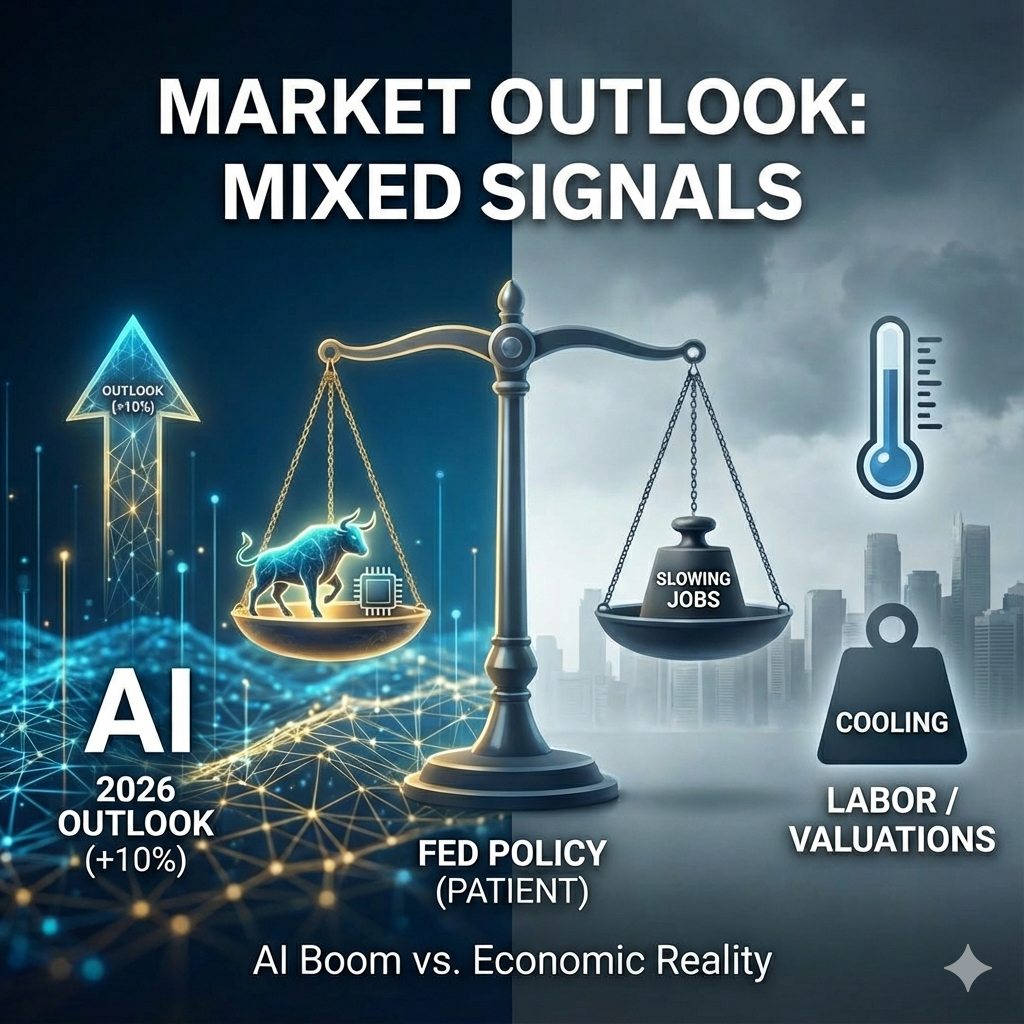
Market Outlook: Mixed Signals
The S&P 500 finished the holiday-shortened week down 1.35%, a quiet end to what was anything but a quiet year. Investors are catching their breath and asking the obvious question: Can this bull market keep running? The answer, as always, depends on who you ask and which data you choose to believe.
2025 ended with mixed signals. GDP growth hit an annualized 4.3% in Q3, beating expectations, though the expansion was driven largely by AI infrastructure spending as companies pour hundreds of billions into data centers and computing power. Strip out that investment, and the picture looks considerably softer. The labor market has cooled. Unemployment climbed to 4.6% in November from 4.1% in June, and November payrolls showed the economy adding just 64,000 jobs, though the government shutdown complicated data collection. The pattern that defined most of 2025 remains intact: slow to hire, slow to fire.
What I'mWatching:
- Growth Outlook: The Federal Reserve Bank of Atlanta projects Q4 GDP growth slowing to 3%, a step down from Q3's surge.
- Inflation: November's reading came in at 2.7%, down from 3% in September. The Federal Reserve Bank of Cleveland's models suggest price pressures continue drifting toward the Fed's 2% target, though the last mile may take time.
- Rate Expectations: Markets are pricing in a patient Fed. The CME FedWatch tool shows expectations for just two additional rate cuts through the end of 2027.
- Market Outlook: Wall Street strategists expect the S&P 500 to climb roughly 10% in 2026, though valuations remain stretched.
Initial Claims for Unemployment Insurance
Initial jobless claims, which track how many Americans filed for unemployment benefits for the first time, dropped to 199,000 for the week ending December 27, the lowest level in a month. The four-week moving average, which smooths out week-to-week swings, rose slightly to 218,750. Continuing claims, measuring people actively receiving benefits, fell to 1.87 million for the week ending December 20, down 47,000 from the prior week. These figures suggest employers are holding onto workers despite typical holiday-season volatility, a positive signal for job security heading into 2026.
U.S. Department of Labor (2025) Unemployment Insurance Weekly Claims, USDL 25-1646-NAT. Available at: https://www.dol.gov/ui/data.pdf (Accessed: 31 December 2025).
Pending Home Sales
| Region | MoM Change | YoY Change |
|---|---|---|
| West | +9.2% | +2.4% |
| South | +2.4% | +3.3% |
| Northeast | +1.8% | +1.8% |
| Midwest | +1.3% | +2.2% |
Pending home sales, which track signed contracts before closings finalize, rose 3.3% in November from October and 2.6% compared to last year. This marks the strongest performance since February 2023. For families considering a move, the uptick signals improving conditions: mortgage rates have eased from earlier highs, wages are growing faster than home prices, and more homes are available compared to last year. All four regions posted gains, with the West surging 9.2% month-over-month. While housing remains expensive, these trends suggest buyers are finding slightly better footing heading into 2026.
National Association of Realtors (2025) NAR Pending Home Sales Report Shows 3.3% Increase in November. Available at: https://www.nar.realtor/newsroom/nar-pending-home-sales-report-shows-3-3-increase-in-november (Accessed: 31 December 2025).
Case-Shiller 20-City Home Price Index
Regional Performance (Year-over-Year)
| Top Gainers | Change | Top Decliners | Change |
|---|---|---|---|
| Chicago | +5.8% | Tampa | -4.2% |
| New York | +5.0% | Phoenix | -1.5% |
| Cleveland | +4.1% | Dallas | -1.5% |
|
|
|
Miami | -1.1% |
Home prices across 20 major U.S. cities rose just 1.3% over the past year, the smallest annual gain since July 2023. This index, which tracks repeat sales of single-family homes, shows the housing market settling into a much slower growth phase. The market is splitting geographically: Midwest and Northeast cities like Chicago and New York continue gaining value, while Sun Belt markets that boomed during the pandemic are now declining. Tampa has posted year-over-year price declines for 12 consecutive months, down 4.2% from last year, making it the weakest market among the 20 cities tracked.
S&P Cotality (2025) S&P Cotality Case-Shiller Home Price Indices. Available at: https://www.spglobal.com/spdji/en/index-family/indicators/sp-corelogic-case-shiller/ (Accessed: 31 December 2025).
S&P Global US Manufacturing PMI
The Purchasing Managers' Index, or PMI, measures whether manufacturing conditions are expanding or contracting. Readings above 50 signal expansion, while below 50 indicates contraction. December's reading of 51.8 shows manufacturing conditions continued to expand, though the pace cooled to the weakest level in the current five-month growth phase. New orders fell for the first time in a year, meaning fewer customers are placing purchases. Exports dropped for a seventh straight month as tariffs and trade tensions hurt overseas sales. Despite these headwinds, manufacturers added workers in anticipation of stronger conditions in 2026. Input costs eased to an 11-month low but stayed elevated, while selling price increases slowed to the weakest pace since early 2025.
S&P Global (2026) S&P Global US Manufacturing PMI. Available at: https://www.pmi.spglobal.com (Accessed: 2 January 2026).
Disclosure
This material is provided by Todd Van Der Meid, MBA, CFP®, through Rhino Wealth Management, Inc., a Registered Investment Adviser, solely for informational purposes. It is not intended as investment, tax, legal, or accounting advice. Investors should consult qualified professionals before making financial decisions.
Opinions expressed herein are general in nature and not tailored to individual circumstances. Investment strategies discussed may not be suitable for every investor. All investments carry risk, including possible loss of principal, and past performance does not guarantee future results. No investment strategy or risk management technique ensures profit or eliminates risk in all market conditions.
Investments in foreign or emerging markets involve additional risks, such as currency fluctuations, geopolitical instability, and varying accounting standards. Sector-specific investments can be more volatile due to their concentrated nature. References to indexes are for illustrative purposes; indexes are unmanaged, cannot be invested into directly, and their performance does not reflect fees, expenses, or sales charges. Index performance is not indicative of specific investment performance.
Economic forecasts and forward-looking statements reflect current views and assumptions and are subject to change. Actual results may vary materially due to market or other conditions. There is no obligation to update forward-looking information.
Information presented herein comes from reliable third-party sources but is not guaranteed for accuracy or completeness. Rhino Wealth Management, Inc. disclaims liability for errors or omissions. Portions of this content may be generated using advanced analytical tools, including artificial intelligence, and all such content has been reviewed and validated by Todd Van Der Meid, MBA, CFP®, using proprietary quality-control measures. Rhino Wealth Management, Inc. does not directly hold securities; however, securities mentioned may be included within recommended portfolio models or held by clients. Please refer to our Form ADV for additional details regarding potential conflicts of interest.