

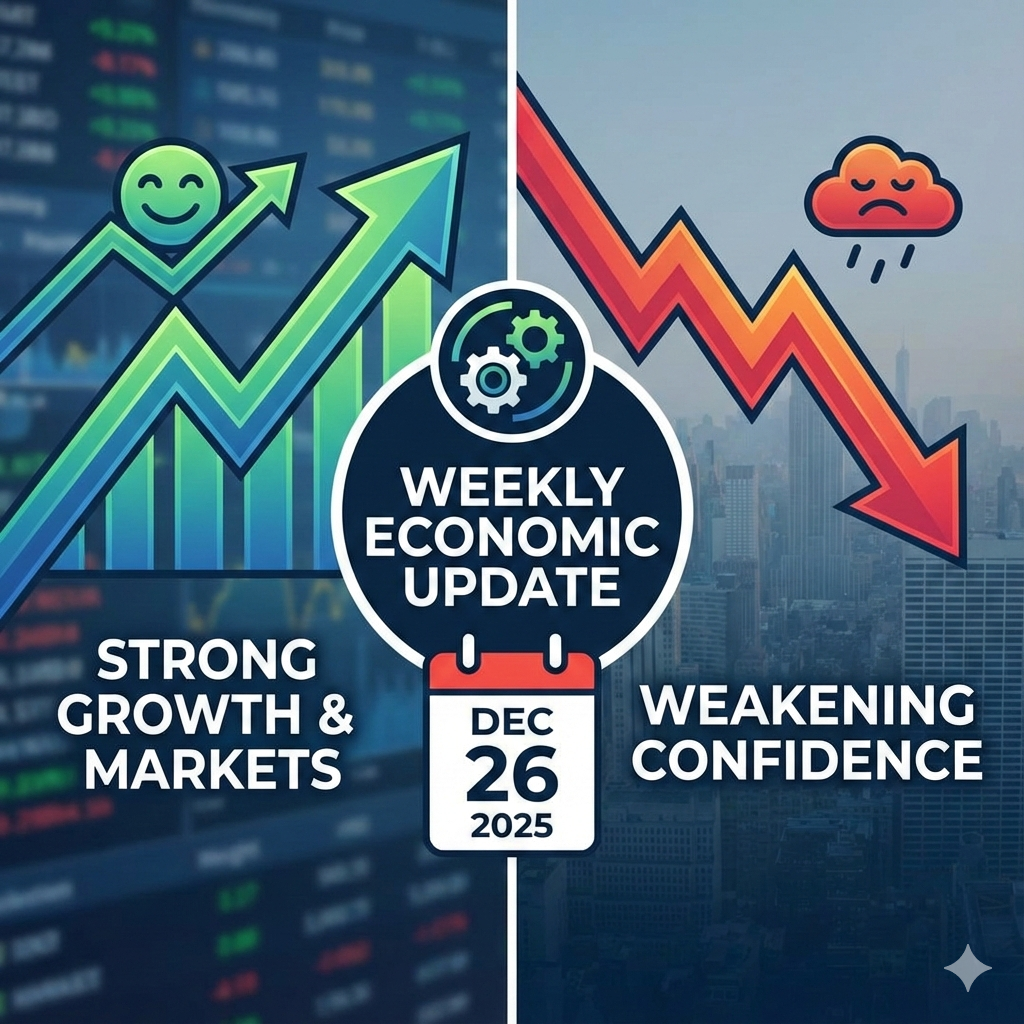
Strong Growth, Shaky Confidence
The economy is closing out 2025 with a familiar split personality: strong growth numbers paired with weakening confidence measures. Understanding what these crosscurrents mean requires looking beyond the headlines.
The Good News First
Third-quarter GDP came in at 4.3% annualized growth, the fastest pace in two years. Consumer spending and rebounding exports drove most of that strength. The Atlanta Fed projects a still-solid 3.0% growth rate for Q4, suggesting the expansion has legs heading into 2026.
The labor market continues its slow-motion normalization. Initial jobless claims dropped to 214,000, the lowest reading since early 2024. Employers aren't rushing to cut headcount despite all the uncertainty swirling around policy and global trade.
The Warning Lights
Here's where things get interesting. Consumer confidence fell for the fifth consecutive month, landing at 89.1. More concerning: the Expectations Index has been stuck below 80 for eleven straight months. That 80 threshold matters because readings below it have historically preceded recessions.
The jobs picture isn't entirely rosy either. Continuing claims rose to 1.92 million, which tells us something important. Companies aren't laying people off, but they're not exactly hiring aggressively either. It's a holding pattern that can't last forever.
Durable goods orders dropped 2.2% in October, worse than economists expected. The bright spot here: core capital goods (think business equipment purchases) rose 0.5%. Businesses haven't completely abandoned their investment plans, even if they're being cautious.
Industrial production ticked up just 0.2% in November and remains well below capacity. Factories have room to ramp up, but they're waiting for clearer signals before doing so.
What Markets Are Telling Us
Despite these crosscurrents, markets had a solid holiday-shortened week. The S&P 500 gained 1.4%, potentially kicking off what traders call the Santa Claus Rally.
This seasonal pattern covers the last five trading days of December and the first two of January. It's occurred more than 75% of the time historically, with an average return of 1.3%. Whether this year follows the pattern remains to be seen, but the early signs are encouraging.
The Bottom Line
We're seeing an economy that's growing faster than most expected while consumers grow increasingly nervous about what comes next. That disconnect can't persist indefinitely. Either confidence rebounds as growth continues, or the pessimism eventually shows up in spending decisions.
For now, the hard data (GDP, jobs, spending) outweighs the soft data (confidence surveys, expectations). But those soft measures often lead the hard ones by several months. We'll be watching closely as 2026 begins.
US Durable Goods New Orders
| Category | Value | Change |
|---|---|---|
| Transportation Equipment | $103.9B | -6.5% |
| Capital Goods | $107.4B | -5.6% |
| Machinery | $40.0B | +0.8% |
| Fabricated Metal Products | $41.9B | +0.5% |
| Primary Metals | $27.2B | -0.7% |
Why does this matter to you? Durable goods orders are purchases of big-ticket items like appliances, vehicles, and machinery. They signal whether businesses feel confident enough to invest in the future. When companies pull back, it often foreshadows slower hiring and economic growth. In October, these orders fell 2.2% to $307.4 billion, worse than the expected 1.5% decline and reversing September's gains. Aircraft orders drove most of the weakness, with nondefense aircraft plunging 20.1%. The silver lining: core capital goods orders, a proxy for business investment excluding volatile aircraft, rose 0.5%, suggesting companies haven't abandoned their spending plans entirely.
U.S. Census Bureau (2025) Advance Report on Durable Goods Manufacturers' Shipments, Inventories and Orders: October 2025. Available at: https://www.census.gov/manufacturing/m3/adv/current/index.html (Accessed: 26 December 2025).
US Real GDP – Third Quarter 2025
| GDP Component | Q3 2025 | Q2 2025 | Change |
|---|---|---|---|
| Real GDP (annualized) | 4.3% | 3.8% | ▲ +0.5 pp |
| Consumer Spending | 3.5% | 2.5% | ▲ +1.0 pp |
| Fixed Investment | 1.0% | 4.4% | ▼ -3.4 pp |
| Exports | 8.8% | -1.8% | ▲ +10.6 pp |
| Government Spending | 2.2% | -0.1% | ▲ +2.3 pp |
A growing economy typically means more jobs, rising wages, and greater confidence for household spending. Gross Domestic Product (GDP), the total value of all goods and services produced in the country, grew at an annualized rate of 4.3% in the third quarter of 2025, the fastest pace in two years and well above the 3.3% economists had predicted. Consumer spending, which accounts for roughly two-thirds of economic activity, jumped 3.5% as Americans increased purchases of both goods and services, particularly healthcare and travel. Exports surged 8.8%, rebounding sharply after declining in Q2, while imports fell 4.7%. Business investment in equipment and intellectual property remained positive, though investment in buildings and housing continued to contract. The Atlanta Fed's GDPNow model projects Q4 2025 growth at 3.0%, suggesting continued economic expansion though at a slower pace.
U.S. Bureau of Economic Analysis (2025) Gross Domestic Product, Third Quarter 2025 (Third Estimate). Available at: https://www.bea.gov/data/gdp/gross-domestic-product (Accessed: 26 December 2025).
Federal Reserve Bank of Atlanta (2025) GDPNow. Available at: https://www.atlantafed.org/cqer/research/gdpnow (Accessed: 26 December 2025).
US Industrial Production
| Sector | October | November | Net Change |
|---|---|---|---|
| Manufacturing | -0.4% | 0.0% | ▼ Net decline |
| Mining | -0.8% | +1.7% | ▲ Net gain |
| Utilities | +2.6% | -0.4% | ▲ Net gain |
When factories produce more goods, it typically means more jobs, steadier prices on store shelves, and a healthier economy overall—which is why industrial production matters to your household budget. Industrial production—a measure of output from factories, mines, and utilities—rose 0.2% in November after dipping 0.1% in October. Manufacturing was flat in November following a 0.4% October decline, while mining and utilities posted net gains over the two-month period. Capacity utilization—the share of industrial capacity currently in use—held at 76.0%, remaining 3.5 percentage points below the long-run average. This gap suggests factories can ramp up output to meet demand without triggering the kind of supply shortages that push prices higher.
Board of Governors of the Federal Reserve System (2025) Industrial Production and Capacity Utilization - G.17. Available at: https://www.federalreserve.gov/releases/g17/ (Accessed: 26 December 2025).
Consumer Confidence Index
When families decide whether to buy a new car, take a vacation, or simply spend a little extra at the grocery store, those choices ripple through the entire economy. The Consumer Confidence Index measures exactly this: how optimistic or worried Americans feel about their financial future. When confidence drops, people pull back on spending, and businesses feel it. December's numbers suggest many households are tightening their belts heading into 2026.
Consumer confidence fell for the fifth consecutive month in December, dropping to 89.1 and approaching the April low of 85.7 when tariffs first rolled out. The Present Situation Index, which captures how people view current business and job conditions, plunged 9.5 points to 116.8. Meanwhile, the Expectations Index (measuring optimism about the next six months) held at 70.7, marking eleven straight months below 80. That threshold has historically signaled recession risk. Survey respondents cited inflation, tariffs, and job market concerns as top worries. Notably, consumers' views of their family's current financial situation turned negative for the first time in nearly four years.
The Conference Board (2025) Consumer Confidence Index. Available at: https://www.conference-board.org/topics/consumer-confidence (Accessed: 26 December 2025).
Weekly Initial Jobless Claims
Initial jobless claims—the number of people filing for unemployment benefits for the first time—dropped to 214,000 for the week ending December 20th, the lowest reading since early 2024. The 4-week moving average, which smooths out weekly fluctuations, also declined to 216,750. However, continuing claims (people still receiving benefits week after week) rose for a second consecutive week to 1.92 million. This divergence reinforces the "No Fire, No Hire" pattern defining today's labor market: employers aren't laying off workers, but they're not adding new positions either. For job seekers, this means greater job security if you're currently employed, but a longer, more competitive search if you're looking for work.
U.S. Department of Labor (2025) Unemployment Insurance Weekly Claims. Available at: https://www.dol.gov/ui/data.pdf (Accessed: 26 December 2025).
Disclosure
This material is provided by Todd Van Der Meid, MBA, CFP®, through Rhino Wealth Management, Inc., a Registered Investment Adviser, solely for informational purposes. It is not intended as investment, tax, legal, or accounting advice. Investors should consult qualified professionals before making financial decisions.
Opinions expressed herein are general in nature and not tailored to individual circumstances. Investment strategies discussed may not be suitable for every investor. All investments carry risk, including possible loss of principal, and past performance does not guarantee future results. No investment strategy or risk management technique ensures profit or eliminates risk in all market conditions.
Investments in foreign or emerging markets involve additional risks, such as currency fluctuations, geopolitical instability, and varying accounting standards. Sector-specific investments can be more volatile due to their concentrated nature. References to indexes are for illustrative purposes; indexes are unmanaged, cannot be invested into directly, and their performance does not reflect fees, expenses, or sales charges. Index performance is not indicative of specific investment performance.
Economic forecasts and forward-looking statements reflect current views and assumptions and are subject to change. Actual results may vary materially due to market or other conditions. There is no obligation to update forward-looking information.
Information presented herein comes from reliable third-party sources but is not guaranteed for accuracy or completeness. Rhino Wealth Management, Inc. disclaims liability for errors or omissions. Portions of this content may be generated using advanced analytical tools, including artificial intelligence, and all such content has been reviewed and validated by Todd Van Der Meid, MBA, CFP®, using proprietary quality-control measures. Rhino Wealth Management, Inc. does not directly hold securities; however, securities mentioned may be included within recommended portfolio models or held by clients. Please refer to our Form ADV for additional details regarding potential conflicts of interest.