

The Data Returns: Signs of a Cooling Economy
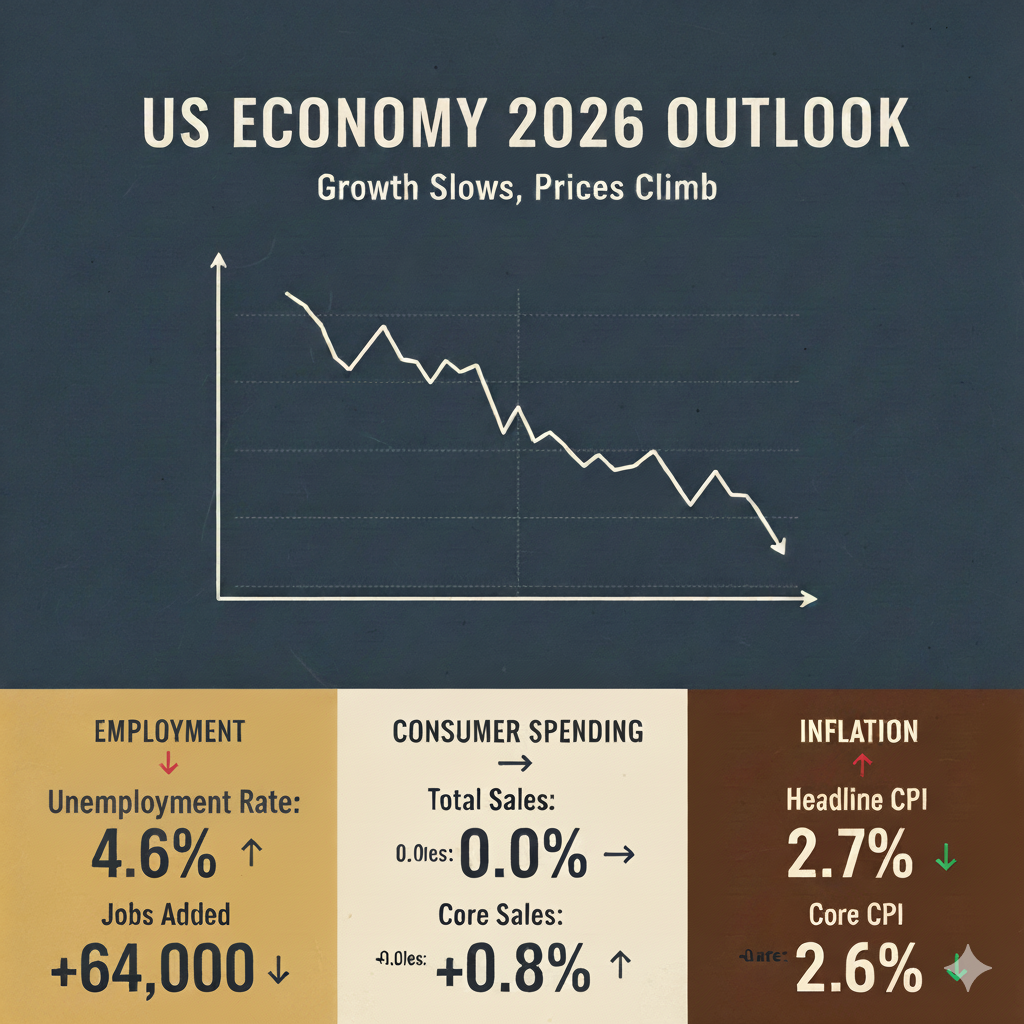
The S&P 500 finished another volatile week, ending up just 0.10%. That volatility reflects the mixed signals now coming from delayed economic data after the longest government shutdown in U.S. history, and the picture it paints is one of an economy losing momentum heading into 2026. The job market continues to soften, with unemployment climbing to 4.6% and payroll gains falling well below average. Inflation cooled to 2.7%, but the Federal Reserve signaled it's in no rush to cut rates further. Consumer sentiment sits near record lows, even as core retail sales surprised to the upside. Meanwhile, businesses report some of their sharpest cost increases in three years, with tariffs already pushing prices higher. The data carries significant caveats after a 43-day collection gap, but the trend is clear: growth is slowing while price pressures persist.
Employment
When people have jobs, they have money to spend on goods and services. Consumer spending accounts for nearly 70% of U.S. GDP, making employment the foundation of a healthy economy.
Jobs Report
| Sector | November Change |
|---|---|
| Health Care | +46,000 |
| Construction | +28,000 |
| Social Assistance | +18,000 |
| Federal Government | -6,000 |
| Transportation & Warehousing | -18,000 |
The U.S. job market softened in late 2025. Nonfarm payrolls, which measure total paid workers excluding farm employees, fell by 105,000 in October before adding just 64,000 in November. The unemployment rate rose to 4.6%, its highest level in four years. A 43-day federal government shutdown disrupted data collection and left October's household survey data unavailable. Average hourly earnings grew 3.5% year-over-year, barely outpacing inflation. Health care and construction showed strength, while federal employment and transportation sectors continued their sharp declines.
Bureau of Labor Statistics (2025) Employment Situation Summary – November 2025. Available at: https://www.bls.gov/news.release/empsit.nr0.htm (Accessed: 16 December 2025).
Initial Jobless Claims
Initial jobless claims (the number of Americans filing for unemployment benefits for the first time) fell to 224,000 for the week ending December 13, reversing the prior week's spike. This came in slightly better than forecasters expected (225,000). Continuing claims (people still receiving benefits after their first week) rose to 1.897 million, though this was better than the 1.93 million forecast. The data reflects a "low-hire, low-fire" job market: employers aren't cutting workers aggressively, but those who lose jobs face longer searches. Holiday-season adjustments make these weekly figures volatile, so the 4-week average (217,500) provides a more reliable signal.
U.S. Department of Labor (2025) Unemployment Insurance Weekly Claims Report USDL 25-1602-NAT. Available at: https://www.dol.gov/ui/data.pdf (Accessed: 18 December 2025).
Consumer Spending
Consumer spending accounts for nearly 70% of U.S. GDP. To get a fuller picture, we look at whether consumers are spending money and what they're spending it on. People who feel confident about their employment and financial situation make more discretionary purchases. As that confidence declines, a larger share of spending shifts toward necessities and consumer staples.
Retail Sales Report
| Strongest Sectors | MoM | Weakest Sectors | MoM |
|---|---|---|---|
| Furniture & Home | +2.3% | Motor Vehicles | −1.6% |
| Sporting Goods & Books | +1.9% | Building Materials | −0.9% |
| Online Retailers | +1.8% | Gasoline Stations | −0.8% |
October retail sales totaled $732.6 billion, unchanged from September and missing forecasts for modest growth. However, the real story lies beneath the headline. Core retail sales jumped 0.8%, double what economists expected. This measure strips out volatile categories like cars, gas, and building supplies to reveal underlying consumer demand, which matters because core sales feed directly into GDP calculations. Weakness in auto sales (down 1.6%, partly due to expired electric vehicle subsidies) and lower gas prices dragged down the headline number. Meanwhile, online shopping continued its dominance with 9% year-over-year growth, and furniture stores posted their strongest gains in months.
U.S. Census Bureau (2025) Advance Monthly Sales for Retail and Food Services, October 2025. Available at: https://www.census.gov/retail/index.html (Accessed: 16 December 2025).
Inflation
Inflation measures how quickly prices rise across the economy. When inflation outpaces wage growth, households lose purchasing power and can afford less with each paycheck. The Federal Reserve's primary tool for fighting inflation is raising interest rates, which makes borrowing more expensive and slows economic activity. That's why inflation data, particularly the Consumer Price Index, ranks among the most market-moving reports each month.
Consumer Price Index (CPI): November 2025
| Category | 12-Month Change |
|---|---|
| Shelter | +3.0% |
| Food | +2.6% |
| Energy | +4.2% |
| Medical Care | +2.9% |
| Used Cars & Trucks | +3.6% |
| Apparel | +0.2% |
The Consumer Price Index, a measure of how much everyday goods and services cost, rose 2.7% over the 12 months ending November 2025, down from 3.0% in September and below the 3.1% forecast. Core CPI, which excludes volatile food and energy prices, came in at 2.6%, its lowest reading since March 2021. Shelter costs (housing, rent) increased 3.0%, while energy prices jumped 4.2%, led by fuel oil (+11.3%) and electricity (+6.9%). Economists caution that data collection disruptions from the government shutdown may have distorted these figures. The December CPI, due January 13, 2026, should provide cleaner data for assessing inflation trends.
U.S. Bureau of Labor Statistics (2025) Consumer Price Index — November 2025. Available at: https://www.bls.gov/news.release/cpi.nr0.htm (Accessed: 18 December 2025).
The Housing Market
For many American households, their home is their largest single asset. A healthy housing market fuels jobs in construction, lending, and home improvement while shaping how confident consumers feel about their finances. When home values rise, homeowners feel wealthier and spend more freely. Because mortgages tie up household budgets for decades, housing trends often signal broader shifts in consumer confidence and economic momentum.
Existing Home Sales
| Region | Sales (SAAR) | MoM | Median Price |
|---|---|---|---|
| Northeast | 510,000 | +4.1% | $480,800 |
| Midwest | 970,000 | -2.0% | $319,400 |
| South | 1.89M | +1.1% | $361,000 |
| West | 760,000 | 0.0% | $618,900 |
Existing home sales (resales of previously owned homes) rose 0.5% in November to a seasonally adjusted annual rate of 4.13 million units, marking the third consecutive monthly increase and the highest pace in nine months. Despite monthly gains, sales remain 1.0% below year-ago levels. The median sale price climbed 1.2% year-over-year to $409,200, representing the 29th straight month of annual price increases. Housing inventory (the number of homes available for sale) fell 5.9% from October to 1.43 million units, translating to 4.2 months of supply. NAR Chief Economist Lawrence Yun noted that lower autumn mortgage rates drove the sales uptick, but cautioned that inventory growth is beginning to stall.
National Association of Realtors (2025) Existing-Home Sales Report, November 2025. Available at: https://www.nar.realtor/research-and-statistics/housing-statistics/existing-home-sales (Accessed: 19 December 2025).
Business Activity
Business surveys tell us what's happening on the ground before it shows up in official data. When companies report rising orders, they typically hire more workers and increase production in the months ahead. When they report cost pressures, those costs eventually reach consumers as higher prices. The Purchasing Managers' Index surveys thousands of businesses each month about new orders, employment, inventories, and prices, making it one of the earliest signals of where the economy is heading.
S&P Global Flash US Composite PMI
The Purchasing Managers' Index (PMI)—a survey measuring business activity where readings above 50 signal growth—fell to a six-month low in December. The economy continues expanding, but at the weakest pace since June. New orders posted the smallest increase in 20 months, and employment growth softened to marginal levels as firms restrained hiring. Meanwhile, businesses face some of the sharpest cost increases in roughly three years, with tariffs cited as a key factor driving input prices higher. Companies are passing these costs to customers, pushing selling price inflation to one of the steepest rates since mid-2022. S&P Global estimates this data points to roughly 2.5% annualized GDP growth for Q4.
S&P Global (2025) S&P Global Flash US PMI – December 2025. Available at: https://www.pmi.spglobal.com/Public/Home/PressRelease/Flash_US (Accessed: 16 December 2025).
Disclosure
This material is provided by Todd Van Der Meid, MBA, CFP®, through Rhino Wealth Management, Inc., a Registered Investment Adviser, solely for informational purposes. It is not intended as investment, tax, legal, or accounting advice. Investors should consult qualified professionals before making financial decisions.
Opinions expressed herein are general in nature and not tailored to individual circumstances. Investment strategies discussed may not be suitable for every investor. All investments carry risk, including possible loss of principal, and past performance does not guarantee future results. No investment strategy or risk management technique ensures profit or eliminates risk in all market conditions.
Investments in foreign or emerging markets involve additional risks, such as currency fluctuations, geopolitical instability, and varying accounting standards. Sector-specific investments can be more volatile due to their concentrated nature. References to indexes are for illustrative purposes; indexes are unmanaged, cannot be invested into directly, and their performance does not reflect fees, expenses, or sales charges. Index performance is not indicative of specific investment performance.
Economic forecasts and forward-looking statements reflect current views and assumptions and are subject to change. Actual results may vary materially due to market or other conditions. There is no obligation to update forward-looking information.
Information presented herein comes from reliable third-party sources but is not guaranteed for accuracy or completeness. Rhino Wealth Management, Inc. disclaims liability for errors or omissions. Portions of this content may be generated using advanced analytical tools, including artificial intelligence, and all such content has been reviewed and validated by Todd Van Der Meid, MBA, CFP®, using proprietary quality-control measures. Rhino Wealth Management, Inc. does not directly hold securities; however, securities mentioned may be included within recommended portfolio models or held by clients. Please refer to our Form ADV for additional details regarding potential conflicts of interest.